

Alps 2024 – the recap
It didn’t go at all the way we’d pictured it — and that’s exactly the charm of it. The original plan was the Tour de Monte Rosa loop, which is usually possible to walk through in July, including a stretch that crosses a glacier. This year’s heavy precipitation, whether rain or snow (it was still snowing there in June), meant the higher sections were buried under piles of snow and the lower ones had been damaged by landslides. Snow can be fun for a while, but if you’re supposed to walk through it for 5 hours a day with permanently soaked shoes, and you have the option to change plans, it’s worth taking it.

We naively hoped that pushing our crossing back by 10 days would be enough. So we went to warm up in the Val Grande area, which I’d recommend to anyone who loves brutal climbs, unmaintained trails, next to nobody around, and a fantastic mountain hut around every corner. We went in with zero preparation, just offline maps on our phones.


After three days we joined the route I’d originally planned back home as a kind of final wander. We were struck by how deserted it was everywhere — you don’t meet a single soul all day, and the mountains around are absolutely gorgeous.

We found out that pushing it a a few days wouldn’t be enough, in a pass at 2400 m of altitude, where we were the first people through that year, and it was still buried under a solid layer of snow. That was the moment we said our final goodbye to the Tour de Monte Rosa and put away in a drawer for another time. We needed a new plan.


We wanted to stay in Italy and head to Gran Paradiso National Park. We planned out roughly 5 days of walking, approximate places to sleep, how much food we’d need and how to get there. Everything came together pretty well — we hitchhiked a car fast, stocked up on supplies, sat on the train. Scrolling through hiking Facebook groups, I notice that Écrins (where we’d been the year before) is also completely under snow, and I come across a snow map. Sure enough, Gran Paradiso turns out to be entirely under snow too, on top of having brutal flooding too — so I talked Jozef into heading to the Cottian Alps instead.


Those turn out to be completely passable, and in the end we even cross into their French side, since there’s a beautiful loop, GR 58, around the Queyras nature park (the Tour du Queyras). And it turns out to be a great call — stunning views, good trails, just the right number of people, and marmots everywhere. Over the last few days we push ourselves pretty hard, and our bodies start making it clear they’ve had enough.


We’re probably learning our lesson, and next time we’ll have a rest day after 10 days on the trail. In the end we spent 6 days in France, and the only thing we’re sorry about is not getting a flan cake there. All together, we covered over 350 km and nearly 23000 meters of elevation gain — roughly the equivalent of walking from Tatranská Lomnica up to Slavkovský štít and back, every single day, for 14 days straight.
One thing worked out really well, and I’m genuinely happy about it: I did the whole thing in Xero Shoes Mesa Trail barefoot sneakers. I’d been worried about it, since I’d already tried them in Portugal and Mallorca, where my feet started hurting after just a few days. Two months ago I was having issues while running, so I looked into it and discovered I had weak feet, and started working on strengthening them. Wonder of wonders, the problem went away and I stopped having pain. Every day after hiking I’d mobilize and massage my feet. I also walked barefoot on grass, tried to spend some time in a deep squat, on my heels, and released tension in my thighs (all of this I picked up from fyziomluva on Instagram — a really good account on how to add physio into everyday activities and become your own physiotherapist).

Thanks to those exercises, our ultralight gear, and some supplements, we made it through the whole trek without any major issues (aside from the dehydration — lesson learned there). I didn’t even get a cold sore, which usually shows up for me after a few days of hiking. From day one I diligently applied SPF lip balm, and we’ve also been taking omega-3s for a while now, which are anti-inflammatory, so that may have played a role too.

Overall I’d rate this trip very positively — I think it gave us a lot of valuable experience. We had to plan a lot of things on the go, on our phones, walked through plenty of snow and nonexistent trails, and navigated using GPS. We also tested out a few new pieces of gear, but I’ll cover that in a separate article.

After two weeks of wandering through the mountains with everything we need on our backs, we’re savoring the simplicity of it all. As we return to civilization, we put on our cleanest clothes and try to blend back in. It’s not easy — I honestly prefer the mountains, where nobody expects anything of you. We survive the endless journey home and start looking forward to a bed and a shower. Our one-room apartment feels enormous now, after so many nights in a tent. It’s good to reassess every once in a while what you actually need to live: food, sleep, movement, and the occasional shower.

The first thing we did once home was make flan cake, and then went to test our fitness. We track every hike with our watches, and there’s a real difference between walking hills and walking flat ground. When we were in Portugal, my fitness score dropped sharply, but here it held up nicely. On top of that, we were carrying a several-kilo pack the whole time, so once I went for a run up a hill without one, it felt incredibly easy. Jozef’s fitness score actually dropped, since he’s not exactly average person and normally keeps his score sky-high. But 10-12 hours a day on your feet leaves its mark on the body either way. Without any training, he then rode 150 km by bike to Kysuce, and the very next day did another 30 km on the bike plus a 13 km run with me. Those mountains might be brutal, but your body rewards you with fantastic fitness, your head with calm, and nature with incredible views.

Expenses
So how much does a trip like this cost? We were on the road for 17 days — 2 nights in a hotel, 2 nights at a campsite, and 3 nights paying a small fee to camp by a mountain hut. We ate at restaurants 6 times. The food category also includes alcohol, which I’d estimate at around €100. Our highest spending (about €160) came on the last day, when we slept in a hotel, ate out twice, and had three Aperol Spritzes each at one bar. As for grocery prices, Italy is comparable to Slovakia, while France is more expensive. On the other hand, camping in Italy cost us €34 for two people plus a tent, versus €12 in France. France also has better food on top of that, so France wins overall.
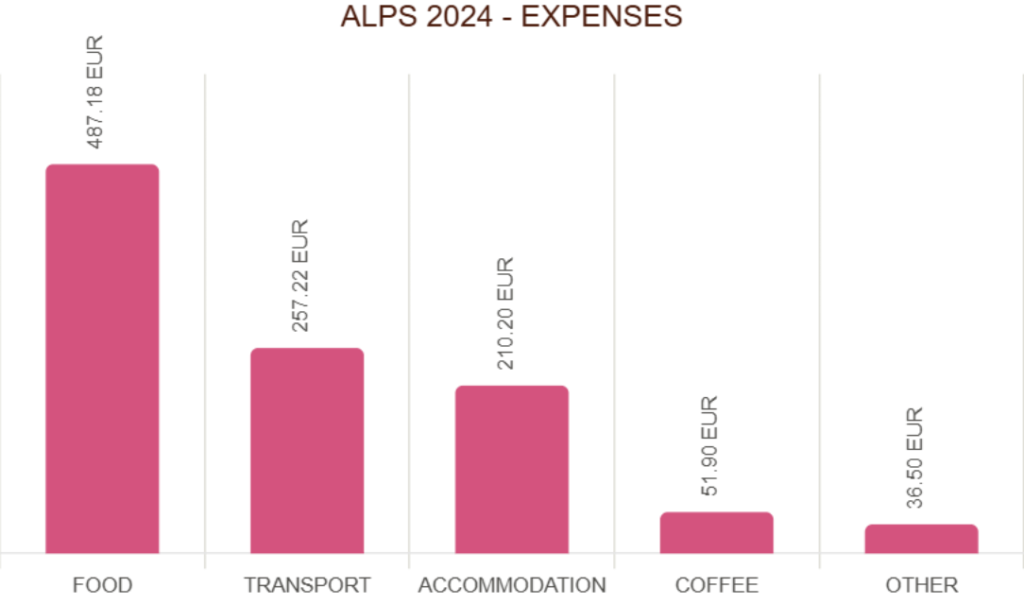
If I’ve wrote down everything correctly, we spent €1043 in total, including flights and transport from Partizánske to the airport. Broken down by day, that comes to roughly €30 per person per day (even with Jozef drinking more beer than me). It could definitely be done cheaper, but we didn’t hold back much.

I’m so glad you’ve been following along on our wanderings. It always makes my day when someone writes to say they enjoy following our trips — that’s exactly what keeps me motivated to keep writing, because there are moments I’d honestly rather just abandon it and simply go walking without documenting any of it. So I hope we’re inspiring you to get out into nature too. Our next destination is unknown, but we can be packed and ready for a hike within the hour, so things can change very quickly. If you want to stay in the loop, be sure to subscribe and you’ll get notified whenever a new article goes up. Thank you <3


